14 Free Calculators · Verified Formulas · No Sign-Up

Plan Your Financial Future with Confidence

Successful wealth creation isn't about timing the market; it's about time in the market. Systematic Investment Plans (SIPs) leverage the power of compounding and rupee cost averaging, turning disciplined monthly savings into substantial long-term wealth. Explore our calculators to see how starting today shapes your tomorrow.

0 VerifiedCalculators
0% FreeNo Paywalls
0% PrivateNo Account Needed
PDF & ExcelInstant Exports

Why use growwithsip?

Most tools give you a single number. We provide the complete picture, detailed breakdowns, and educational guides to help you make informed decisions.

Accurate Calculations

All calculations utilize standard financial equations (e.g. FV of ordinary annuity, EMI reducing balance) verified against bank and government formulas.

Free Forever

No registrations, subscriptions, or credit cards required. Run calculations, access guides, and download reports 100% free.

Beginner Friendly

No complex financial jargon. Intuitive sliders, interactive elements, and clear, step-by-step documentation guide you throughout.

Inflation Adjusted

Easily adjust parameters to see the real purchasing power of your money in today's terms. Never get misled by nominal returns.

Instant Charts

Beautiful, interactive visual charts reveal the power of compounding and breakdown of principal vs gains in real time.

Mobile Friendly

Fully responsive layouts designed for smartphones, tablets, and desktops. Run calculations seamlessly on any device.

How It Works

Three simple steps to build your financial plan.

1

Choose a Calculator

Pick from 14 verified tools across compounding investments, retirement planners, and loan EMIs.

2

Enter Your Numbers

Use the intuitive sliders to customize your monthly savings, interest rate, duration, and inflation adjustment in real time.

3

Export Your Plan

Download a comprehensive PDF report or Excel sheet to share with your advisor or track offline.

Learning Center

Beginner's Guide to Investing

New to personal finance? Let's demystify the essential pillars of smart investing and wealth creation.

Basics

What is Investing?

Investing is the act of allocating capital to assets—such as equities, mutual funds, gold, or real estate—with the expectation of generating an inflation-beating return. While saving keeps your money safe, investing grows your wealth over time by acquiring ownership in productive economic assets.

Wealth Building

What is a Systematic Investment Plan (SIP)?

A Systematic Investment Plan (SIP) is an investment method where you contribute a fixed sum monthly or quarterly to a mutual fund scheme. SIPs teach financial discipline and leverage Rupee Cost Averaging—meaning you buy more units when prices are low and fewer when prices are high, eliminating the need to time the market.

Diversification

What is Mutual Fund Investing?

A mutual fund pools money from thousands of retail investors to purchase a diversified portfolio of equities, debt instruments, or government securities. Managed by certified professional fund managers, mutual funds allow beginners to enjoy instant diversification, high liquidity, and institutional-grade management with minimal capital.

Exponential Growth

How Compounding Works

Compounding is the process where the returns on your investment start earning returns of their own. Over a 5-year period, compounding is slow; but over 15, 20, or 30 years, it grows exponentially. The longer your money stays invested, the more your accumulated interest gains outpace your original principal investment.

Financial Roadmap

The Lifelong Investment Journey

Successful wealth accumulation is a sequential process. Track the five stages of investor lifecycle and see what steps follow.

1

Start Investing

Begin your wealth-building habit with a simple monthly investment to build discipline.

Next: Step Up contributions

Once you build the habit, increase your monthly investment annually to match your salary increments.

2

Increase SIP

Step up your monthly contributions annually as your salary increases to speed up wealth creation.

Next: Track portfolio returns

Evaluate the performance of your overall portfolio using compound annual growth rates (CAGR).

3

Track Portfolio Returns

Calculate compound annual growth rate (CAGR) to benchmark your portfolio performance against inflation.

Next: Plan retirement corpus

Scale your portfolio to target specific life goals and calculate your inflation-adjusted retirement needs.

4

Retirement Planning

Determine your ideal target retirement nest egg, accounting for post-retirement inflation.

Next: Generate passive income

Transition your accumulated retirement corpus into a tax-efficient, steady monthly cash flow.

5

Generate Passive Income

Transition your accumulated corpus into a steady monthly payout via Systematic Withdrawal Plans.

Goal: Financial Freedom

Congratulations! You have completed the loop, securing a sustainable passive income stream for life.

Why Use Investment Calculators in Personal Finance Planning?

Effective wealth building is not a matter of luck or simple guesswork; it is a discipline grounded in mathematical logic. Yet, many retail investors fail to achieve their financial goals because they rely on linear estimations in an environment ruled by exponential forces. The human brain naturally projects growth in straight lines, whereas compound interest grows in curves. Investment calculators act as essential navigation tools, bridging this cognitive gap. By translating complex interest formulas, tax regimes, and inflation adjustments into instant projections, these digital tools empower you to model real-world scenarios and make data-driven decisions.

1. Goal-Based Asset Allocation vs. Reactive Saving

Many individuals save reactively, investing whatever capital is left over at the end of the month. In contrast, successful financial planning requires goal-based investing—working backward from future milestones. Whether you are planning to purchase a home in 5 years, finance a child's higher education in 12 years, or build a retirement corpus, each objective dictates a different timeline and risk profile.

Using a Goal Planner helps you calculate the precise monthly savings rate needed to reach these milestones. By matching your timelines to asset classes—such as low-risk fixed deposits using an FD Calculator for short-term goals, or equity mutual funds via a SIP Calculator for long-term horizons—you ensure that your asset allocation is aligned with your deadlines.

2. Tackling the Silent Wealth Destroyer: Inflation

The nominal value of money is a common financial illusion. A corpus of ₹1 Crore sounds substantial, but its purchasing power decays every year due to rising costs. In India, where historical consumer price inflation averages between 5% to 6%, the real purchasing power of money halves roughly every 12 years.

To protect your wealth, you must compute your target savings in real, inflation-adjusted terms. For example, if your current monthly expenses are ₹50,000, that same lifestyle will require over ₹2.8 Lakhs per month in 30 years at 6% annual inflation. By inputting these parameters into an inflation-adjusted Retirement Calculator, you can determine the exact corpus needed to prevent running out of money in your golden years.

3. The Power of Systematic Wealth Scaling (Step-Up Compounding)

As your career progresses, your earning capacity grows. Keeping your investments flat over 10 or 20 years misses a major wealth-building opportunity. A Step-Up Systematic Investment Plan (SIP) allows you to increase your monthly contributions by a fixed percentage (e.g., 10%) every year in line with your salary raises.

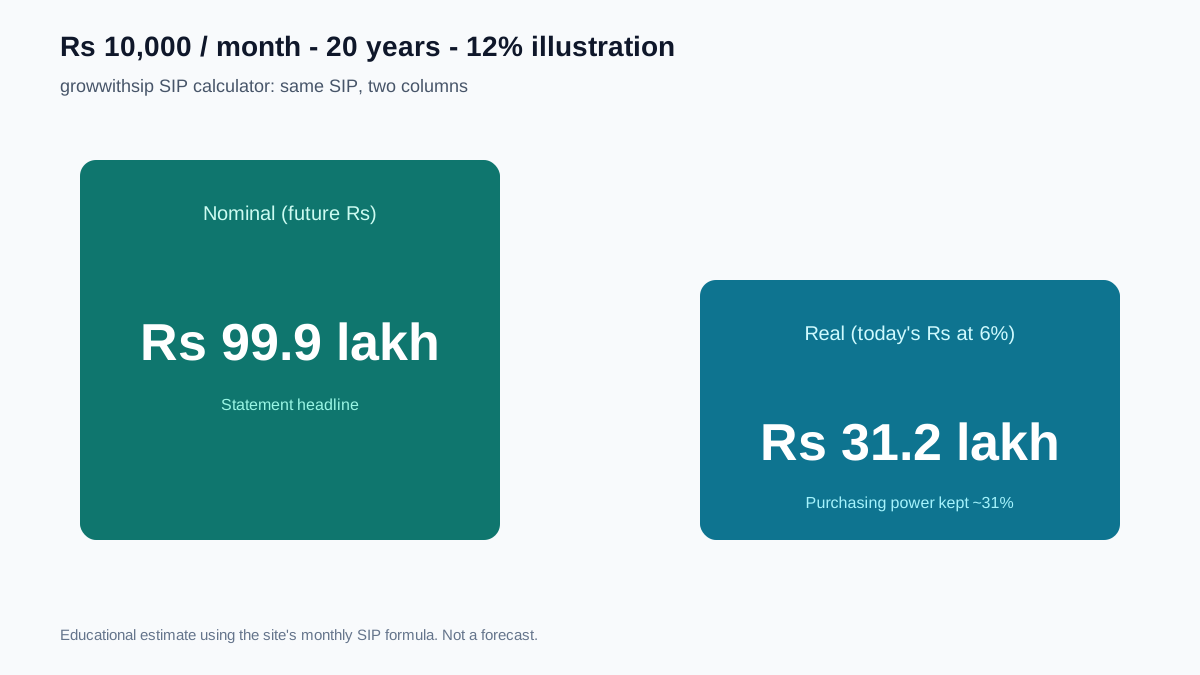
The mathematical impact of this annual step-up is significant. For instance, if you start a flat SIP of ₹10,000 per month for 20 years at a 12% expected annual return, you accumulate approximately ₹99.9 Lakhs. However, if you increase your monthly contribution by just 10% every year, your final corpus grows to ₹2.04 Crores—more than doubling your total wealth with minimal extra effort. By modeling these variables on a Step-Up SIP Calculator, you can see exactly how dynamic wealth scaling accelerates your path to financial freedom.

Comparing Investment Methods: Flat SIP vs. 10% Step-Up SIP

Metrics (20-Year Horizon)Flat SIP (₹10,000/mo)10% Step-Up SIP
Total Amount Invested₹24,00,000₹68,72,000
Estimated Return (12% p.a.)₹75,91,000₹1,35,53,000
Total Accumulated Wealth₹99,91,000₹2,04,25,000

*Table values are rounded estimations based on standard monthly compounding algorithms. Actual returns depend on market variables and fund expenses.

4. Understanding Debt: Amortization Schedules & prepayments

Just as compound interest builds wealth, compounding debt can drain it. Most retail borrowers only look at the monthly installment (EMI) when taking a loan, failing to analyze the total interest cost over the tenure of the loan. Long-term liabilities like home loans operate on a reducing balance basis. In the early years of a 20-year loan, up to 80% of your EMI goes toward paying off interest rather than reducing the principal.

An EMI Calculator generates a detailed amortization schedule, showing the month-by-month breakdown of principal vs. interest. This visualization is critical for planning loan prepayments. Making small, early prepayments directly reduces the outstanding principal, which can shave years off your tenure and save lakhs of rupees in interest. Evaluating these scenarios on a Personal Loan Calculator before borrowing helps prevent over-leveraging.

5. Tax Optimization and Wealth Preservation

Preserving wealth is just as important as generating it. Taxes can significantly impact your net returns over time. In India, tax planning revolves around optimizing deductions (such as Section 80C) and selecting tax-efficient assets. By comparing different schemes, you can choose instruments that align with your tax brackets:

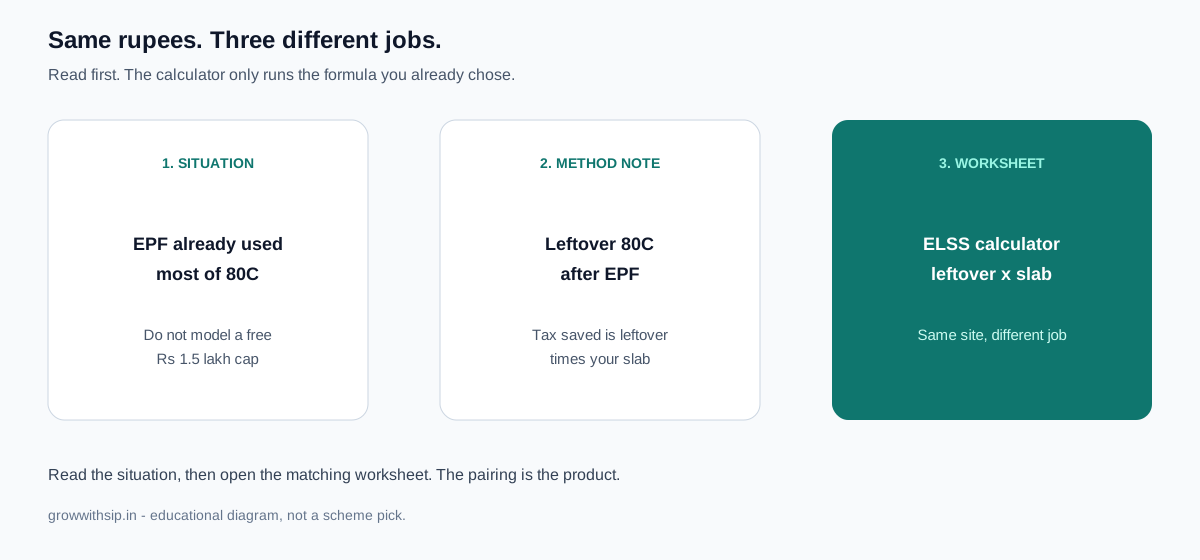
  • ELSS (Equity Linked Savings Scheme): These tax-saving mutual funds carry a short 3-year lock-in period. They offer equity exposure (historically yielding 12-15% returns) but are subject to equity taxation. You can check potential tax savings and returns with our ELSS Calculator.
  • PPF (Public Provident Fund): A secure, government-backed savings plan carrying EEE (Exempt-Exempt-Exempt) tax status. This means the principal invested, interest earned, and maturity amount are completely tax-free. Plan your compounding safety net using our PPF Calculator.
  • NPS (National Pension System): A retirement-focused investment that allows extra tax deductions under Section 80CCD(1B). It operates under a EET/EE hybrid tax structure, which can be modeled using our NPS Calculator to balance annuity payouts and lump-sum withdrawals.

6. Planning Your Distribution Phase with SWPs

Accumulating wealth is only half the battle; the other half is planning how to distribute it. When you reach retirement, you transition from the accumulation phase to the distribution phase. Leaving your entire nest egg in a standard savings account risks losing value to inflation, while keeping it fully in volatile equities risks capital loss during market downturns.

A Systematic Withdrawal Plan (SWP) allows you to withdraw a fixed sum monthly from your mutual fund corpus while leaving the remaining balance invested to compound. This strategy provides regular, tax-efficient passive income while keeping your core assets working for you. By using our SWP Calculator, you can simulate different withdrawal rates to ensure your corpus remains sustainable for life.

Case Study: The Compounding Journey

Consider Investor A and Investor B. Both start a monthly SIP of ₹10,000 at a 12% expected annual return.

  • Investor A invests for 15 years: They invest a total of ₹18 Lakhs. The calculator shows their maturity value is approximately ₹50.45 Lakhs.
  • Investor B invests for 30 years (only twice as long): They invest a total of ₹36 Lakhs. The calculator reveals their maturity value is a staggering ₹3.53 Crores!

Even though Investor B invested only double the capital of Investor A, their ending wealth is **seven times higher**. This demonstrates the exponential power of time. Using calculators makes these compounding curves visible, motivating individuals to start their investments as early as possible.

Exclusive Partner Deal

Launch Your Website with Hostinger

Ready to put your financial planning or personal project online? Hostinger delivers high-performance, secure, and reliable web hosting. Get started today and get an extra discount with our exclusive referral code!

Up to 75% Off + 3 Months Free
Free Domain Name & SSL
Super-fast SSD Storage
30-Day Money-Back Guarantee

Referral / Coupon Code

GROWWITHSIP
Get Hostinger Offer

Click the button above to go to Hostinger. Enter the coupon code GROWWITHSIP at checkout to apply your discount.

Affiliate Disclosure: When you purchase web hosting using our referral link or coupon code, we earn a small commission at no additional cost to you. This helps support our platform and keep these financial tools free for everyone.

Trust & Verification

We understand that financial plans are only as good as the calculations backing them. That's why transparency is core to everything we build at growwithsip.

How calculations are verified:

Every tool uses industry-standard financial math. The Future Value of Annuities computes compounding portfolios; PMT functions determine EMI balances; specialized structures determine PPF and NPS compound curves.

Formula review & update schedules:

Our formulas are peer-reviewed by financial practitioners and verified against official bank calculators. Slabs, investment limits, and rates (e.g. PPF interest changes) are updated dynamically at the start of every fiscal year.

All formulas run directly in your browser. We never collect user inputs.

Editorial Standards

Our content and tools are designed strictly for educational and evaluation purposes. We align our data parameters with publications and standards set by the following official bodies:

We strictly rely on primary, verified governmental and regulatory documentation for calculation inputs. However, growwithsip is an independent, free educational website and does not claim any official affiliation with, sponsorship by, or partnership with these regulatory bodies.

Compliance Note: Not a SEBI registered advisory portal. Please consult certified advisors before taking investment actions.
Got Questions?

Frequently Asked Questions

Clear, straightforward answers to general questions about personal finance, mutual funds, compounding, risk, and long-term planning.

Start Planning Your Wealth Today

No accounts. No paywalls. No tracking. Just instant, precise financial calculations to help you secure a better tomorrow.