What is a Lumpsum Investment?
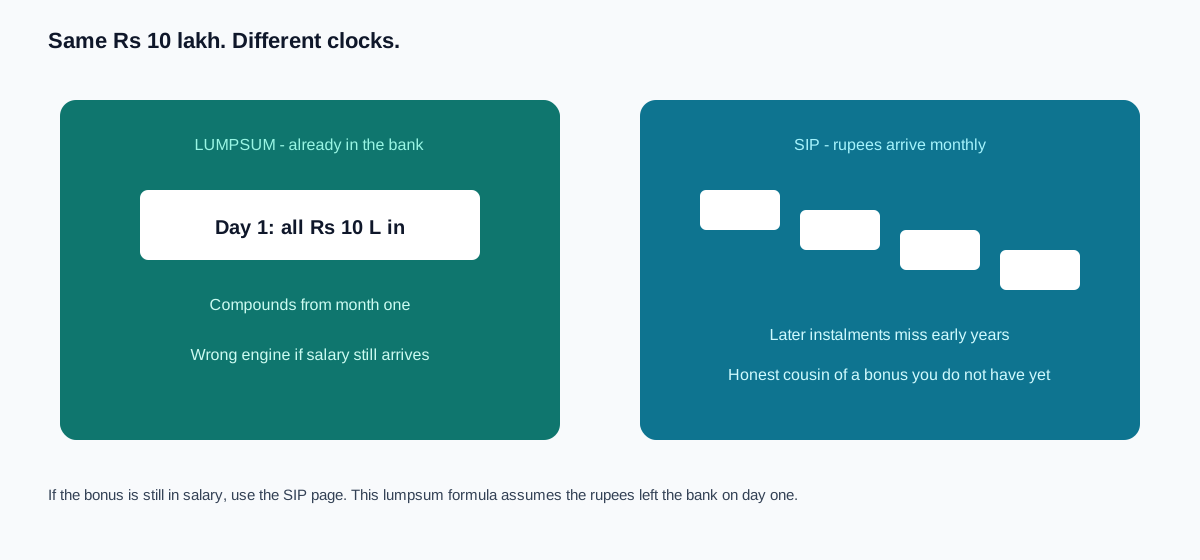
A lumpsum investment is a one-time allocation of a specific sum of money into a financial asset, such as mutual funds, equities, or fixed deposits. Unlike a Systematic Investment Plan (SIP), where you invest smaller amounts at regular intervals, a lumpsum investment exposes the entire principal to market growth and compounding from day one.
Lumpsum investments are particularly useful when you receive a windfall such as an annual corporate bonus, an inheritance, proceeds from a property sale, or maturity payouts from insurance policies. Popular investment platforms in India, such as Groww and Zerodha, make it easy to allocate windfalls directly into equity or debt mutual funds to start building long-term wealth.
What is an Inflation-Adjusted Lumpsum Calculator?
An inflation adjusted lumpsum calculator is a specialized financial planning tool that estimates the maturity value of your one-time investment while discounting it for the eroding effects of inflation.
Standard lumpsum calculators show only the nominal value the raw growth of your capital. While it is exciting to see ₹10 Lakhs compound to a large nominal figure over 20 years, ignoring the rising cost of goods will lead to significant planning gaps. An inflation-adjusted calculator estimates the present value of your future wealth, showing you exactly what that future maturity amount will be worth in terms of today's purchasing power. This calculation is crucial for accurate investment planning.
The Silent Wealth Eroder: Why Inflation Reduces Purchasing Power
Inflation represents the gradual rise in prices of goods and services over time. As inflation increases, each unit of currency buys a smaller percentage of a good or service. This loss of purchasing power is the single greatest threat to long-term savers.
In developing economies like India, consumer price inflation (CPI) averages around 5% to 6% per annum. At a 6% inflation rate, a basket of groceries that costs ₹10,000 today will cost approximately ₹17,900 in 10 years, and nearly ₹32,000 in 20 years. If your investments do not grow faster than the inflation rate, your real wealth is actually shrinking. Thus, calculating real returns (returns after subtracting inflation) is essential to preserve your economic status.
How Inflation Affects One-Time Investments Over 5 to 30 Years
To understand how inflation degrades the purchasing power of cash over different time horizons, let us analyze what happens to a corpus of ₹10 Lakh (₹1,00,0000) if it is left uninvested or placed in an asset that only matches inflation (generating a 0% real return) in an environment with a 6% annual inflation rate:
| Investment Horizon | Nominal Value | Actual Purchasing Power (Today's Value) | Erosion percentage |
|---|---|---|---|
| 5 Years | ₹10.00 Lakh | ₹7.47 Lakh | 25.3% Loss |
| 10 Years | ₹10.00 Lakh | ₹5.58 Lakh | 44.2% Loss |
| 15 Years | ₹10.00 Lakh | ₹4.17 Lakh | 58.3% Loss |
| 20 Years | ₹10.00 Lakh | ₹3.12 Lakh | 68.8% Loss |
| 25 Years | ₹10.00 Lakh | ₹2.33 Lakh | 76.7% Loss |
| 30 Years | ₹10.00 Lakh | ₹1.74 Lakh | 82.6% Loss |
The takeaway: Over a 30-year investment horizon, inflation alone will wipe out more than 82% of your cash's purchasing power. To build a robust inflation adjusted corpus, your money must be placed in productive, compounding assets.
Nominal vs. Real Returns: The Math You Cannot Ignore
When evaluating a mutual fund investment, you will typically see its nominal return (e.g., a scheme boasts a 12% annual return). However, to understand if you are actually building wealth, you must compute the real returns.
A quick mental approximation is:Real Return ≈ Nominal Return - Inflation Rate
For precise financial analysis, economists use the Fisher Equation:1 + Real Rate = (1 + Nominal Rate) / (1 + Inflation Rate)
Which translates to:Real Return = [(1 + Nominal Return) / (1 + Inflation Return)] - 1
Example: If a mutual fund generates a 12% nominal annual return and the local inflation rate is 6%, the real return is:Real Return = (1.12 / 1.06) - 1 = 0.0566 or 5.66%
This means your actual purchasing power expanded by 5.66%, not the nominal 12%.
Future Value vs. Present Value: Bridging the Gap
In financial planning, Future Value (FV) and Present Value (PV) are two sides of the same coin:
- Future Value (FV): The nominal amount of money your investment will grow to, based on compounding interest over a set period.
- Present Value (PV): The discounted value of that future amount in today's currency, representing its true purchasing power.
The mathematical formula used by our calculator to discount future values is:PV = FV / (1 + Inflation Rate)^N
Where N is the number of years. Knowing the PV prevents you from feeling artificially wealthy when looking at large numbers that will buy much less in the future.
Inflation-Adjusted Wealth Creation: Staying Ahead of the Curve
True wealth creation only occurs when your investments consistently yield a positive real return. If you invest in assets that return 6.5% after taxes while inflation runs at 6%, your real growth is a meager 0.47% per year.
To achieve high real growth, you must allocate capital to equity-oriented mutual funds or direct shares. Historically, Indian equities (represented by indices like the Nifty 50 or Sensex) have delivered compounding returns of 12% to 14% over long horizons. Against a 6% inflation rate, this yields a real return of 5.6% to 7.5%, allowing your wealth to double in real terms every 10 to 13 years.
Goal-Based Investing Using Lumpsum Investments
Successful investors do not simply buy funds; they map their assets to specific financial goals. When planning a one-time investment for a future goal, ignoring inflation is a recipe for underfunding:
1. Retirement Planning
If your household expenses are ₹50,000 per month today, you might assume that a retirement corpus that pays ₹50,000 will suffice in 25 years. However, with a 6% inflation rate, you will need ₹2,14,500 per month in 25 years just to maintain the exact same lifestyle. Your retirement target must be computed using inflation-adjusted figures. Learn more using our Retirement Calculator.
2. Child Education Planning
Education inflation in India is notoriously high, often hovering around 8% to 10% per year far exceeding standard consumer price inflation. A professional four-year engineering degree that costs ₹10 Lakh today will likely cost ₹43 Lakh in 15 years. Planning this with a standard calculator will leave a massive deficit; you must plan with an educational inflation rate of at least 8-9%.
3. House Purchase Planning
Real estate prices rise over time, driven by urban migration and input material costs. If a flat costs ₹80 Lakh today, it will cost significantly more in 10 years. Planning a lumpsum down payment requires factoring in property cost inflation to ensure your accumulated corpus is sufficient.
How Much Should You Invest Today to Reach Future Financial Goals?
To find out what size lumpsum is needed today to reach a target, you must first adjust your target for inflation, and then calculate the required present-day deposit based on expected returns.
For instance, if your goal requires ₹50 Lakh in today's money in 15 years, and inflation is 6%, your nominal goal target is:₹50 Lakh * (1.06)^15 = ₹1.19 Crore
Assuming your investment grows at an expected 12% annual rate, the lumpsum you must invest today is:₹1.19 Crore / (1.12)^15 = ₹21.8 Lakhs
You can plan and track complex, multi-stage goals using our interactive Goal Planner.
Common Inflation Assumptions in India
When using a lumpsum return calculator with inflation, varying your assumptions is key to testing the resilience of your financial plan. Here is how different long-term inflation assumptions impact your money:
- 4% Inflation Rate: Representing a highly stable, low-inflation economy (the RBI's medium-term target). Money retains its value longer; purchasing power halves every 18 years.
- 5% Inflation Rate: A moderate, standard assumption for planning stable, high-grade debt investments. Purchasing power halves in 14.2 years.
- 6% Inflation Rate: The most prudent baseline assumption for Indian planning, reflecting historical averages over the last 20 years. Purchasing power halves in 12 years.
- 7% Inflation Rate: A conservative assumption to build a strong margin of safety. Purchasing power halves in 10.2 years.
- 8% Inflation Rate: Reflecting lifestyle inflation or education-specific planning. Purchasing power halves in 9 years.
Real-Life Worked Scenarios: Windfall Growth & Real Wealth
Let us look at how six different one-time investment amounts grow over a 15-year horizon under an expected 12% annual return and a 6% inflation rate:
| Initial Lumpsum | Expected Return (p.a.) | Inflation Rate (p.a.) | Nominal Future Value (15 Years) | Purchasing Power (Today's Money) | Real Wealth Gain (Net of Inflation) |
|---|---|---|---|---|---|
| ₹1 Lakh | 12% | 6% | ₹5.47 Lakh | ₹2.28 Lakh | ₹1.28 Lakh |
| ₹5 Lakh | 12% | 6% | ₹27.37 Lakh | ₹11.42 Lakh | ₹6.42 Lakh |
| ₹10 Lakh | 12% | 6% | ₹54.74 Lakh | ₹22.84 Lakh | ₹12.84 Lakh |
| ₹25 Lakh | 12% | 6% | ₹1.37 Crore | ₹57.10 Lakh | ₹32.10 Lakh |
| ₹50 Lakh | 12% | 6% | ₹2.74 Crore | ₹1.14 Crore | ₹64.20 Lakh |
| ₹1 Crore | 12% | 6% | ₹5.47 Crore | ₹2.28 Crore | ₹1.28 Crore |
Understanding the Scenarios:
- ₹1 Lakh Scenario: Growing to ₹5.47 Lakh in nominal terms seems impressive. However, its actual purchasing power in today's terms is ₹2.28 Lakh. Your real wealth gain the actual net-of-inflation purchasing power created is ₹1.28 Lakh.
- ₹10 Lakh Scenario: Compounding at 12% over 15 years turns your ₹10 Lakh windfall into ₹54.74 Lakh. But due to a 6% annual rise in the cost of living, that ₹54.74 Lakh will buy what ₹22.84 Lakh buys today.
- ₹1 Crore Scenario: A ₹1 Crore one-time investment grows into a massive nominal corpus of ₹5.47 Crore. In terms of actual purchasing power, it represents ₹2.28 Crore in today's economy, generating a real wealth gain of ₹1.28 Crore.
How Investment Duration Changes Inflation-Adjusted Corpus
Time is the ultimate catalyst for compound interest, but it is also the duration over which inflation compiles its eroding effects.
When you invest for 5 years, the impact of inflation is minor, but compounding has not yet reached its explosive phase. When you invest for 25 or 30 years, compounding yields astronomical nominal sums, but inflation erodes the value of each rupee severely. Therefore, the longer your investment horizon, the more vital it is to focus on maximizing your real rate of return rather than settled nominal yields.
Risks of Ignoring Inflation in Financial Planning
Failing to factor inflation into your financial calculations exposes you to several critical risks:
- Underestimating Retirement Requirements: Assuming a static cost of living leads to outliving your savings during your retirement years.
- Shortfalls in Goal Funding: Discovering that the maturity value of an education policy or fixed deposit is insufficient to pay for college admission when the time comes.
- Conservative Portfolio Drag: Holding too much cash, fixed deposits, or physical gold because they seem "safe", while they actually lose real value daily due to negative real yields.
Mistakes Investors Make While Planning Lumpsum Investments
- Timing the Market: Waiting endlessly for the perfect dip to deploy a lumpsum. Historically, time in the market beats timing the market.
- Ignoring Capital Gains Tax: Forgetting that taxes eat into returns. In India, equity mutual fund LTCG above ₹1.25 Lakh is taxed at 12.5%, while STCG (under 1 year) is taxed at 20%. Debt mutual fund returns are taxed at your marginal tax slab rate.
- Deploying All Capital at Peaks: Investing a large lumpsum right before a major correction. Using a Systematic Transfer Plan (STP) from a liquid fund to equity funds is a safer way to average your purchase price.
- Lacking an Emergency Fund: Investing all liquid capital into market assets, forcing you to redeem equities during market lows when unexpected expenses arise.
Inflation Myths vs. Facts
Myth: Fixed Deposits (FDs) are the safest way to preserve wealth.
Fact: While FDs offer capital safety, their post-tax returns rarely beat inflation. With FDs yielding 7% and inflation at 6%, a 30% tax bracket investor receives a net yield of 4.9%, resulting in a negative real return.
Myth: Gold is always the best hedge against inflation.
Fact: Gold preserves wealth over multi-decade cycles, but its short-to-medium term returns can be highly volatile and underperform equity-oriented mutual funds, which compound actual business earnings.
Myth: The official CPI inflation rate represents my personal cost increase.
Fact: Personal inflation depends heavily on consumption patterns. Households spending more on healthcare, private education, and tech products experience higher lifestyle inflation (often 8% to 10%) than the official CPI index.
Advantages and Limitations of Lumpsum Investing
Advantages:
- Maximum Compounding: Your entire capital begins compounding from day one, giving it more time to grow.
- Low Transaction Drag: Single transactions mean fewer operational hassles, lower tracking effort, and fewer platform fees.
- Optimized for Windfalls: Offers an immediate, productive home for idle cash, preventing impulsive spending.
Limitations:
- Valuation Risk: If you invest at a cyclical market peak, it may take years for the investment to break even.
- Psychological Stress: Seeing a large lump sum drop 10% during a short-term market correction requires high emotional discipline.
Lumpsum vs. Alternative Investment Strategies
To build a robust asset allocation plan, you must understand how a lumpsum mutual fund investment compares to other options:
1. Lumpsum vs. SIP
A Systematic Investment Plan (SIP) spreads your investments monthly, helping you average costs and buy more units when markets are down. A lumpsum is a one-time deposit. Lumpsum investments mathematically outperform SIPs in steady bull markets or long-term horizons, while SIPs outperform during volatile or falling markets. Check returns using our SIP Calculator and Step-Up SIP Calculator.
2. Lumpsum vs. Fixed Deposit (FD)
Bank FDs offer guaranteed nominal returns, but carry high tax drag and low real growth. Lumpsum mutual fund investments carry market risk but offer far higher compounding potential, tax efficiency (12.5% LTCG vs slab rate for FD), and a high probability of generating positive real returns over 7+ years. Compare FD yields with our FD Calculator.
3. Lumpsum vs. Gold
Gold is a physical store of value that hedges against geopolitical risks. However, gold does not produce cash flows or business growth. Lumpsum equity investments represent ownership in growing companies, which historically outperform gold over long-term periods.
4. Lumpsum vs. Real Estate
Real estate requires massive capital outlays, is highly illiquid, has high transaction costs (stamp duty, registration), and is localized. Lumpsum mutual fund investments are highly liquid, require low minimum amounts, have negligible transaction costs, and provide instant diversification across dozens of sectors.
5. Lumpsum vs. PPF
The Public Provident Fund (PPF) is a safe, government-backed saving scheme that offers tax-exempt returns. However, it has an annual investment cap of ₹1.5 Lakh and a 15-year lock-in. A lumpsum mutual fund investment offers high liquidity (no lock-in for non-ELSS funds) and significantly higher long-term return potential. Check PPF returns with our PPF Calculator.
6. Lumpsum vs. Debt Funds
Debt mutual funds invest in fixed-income securities like corporate bonds and government gilts. They are less volatile than equity funds, making them ideal for short-to-medium-term horizons (3-5 years). However, for long-term horizons, equity lumpsum investments offer far superior real wealth creation.
Strategic Windfalls Allocation: The STP Approach
If you have a large sum of money but are nervous about market valuations, the most effective strategy is the Systematic Transfer Plan (STP).
Instead of investing the entire lump sum directly into equity funds, you deposit it into a low-risk liquid fund. You then set up automated instructions to transfer a fixed amount (e.g. weekly or monthly) into your target equity mutual funds. This lets you earn stable yields on your idle capital while enjoying the benefit of rupee cost averaging. When you are ready to withdraw systematically in retirement, you can evaluate the returns using our SWP Calculator.
Frequently Asked Questions
Related Calculators
Calculate returns for monthly investments.
Calculate returns with annual investment increases.
Estimate monthly cash flows from a lumpsum corpus.
Check the compound annual growth rate of your assets.
Estimate the inflation-adjusted retirement corpus you need.
Plan and track multiple financial goals in one place.