Why Use an ELSS Calculator?
An elss calculator is a vital online tool for anyone planning their tax-saving investments in India. Equity Linked Savings Schemes (ELSS) are unique tax-saving mutual funds that combine the benefits of wealth creation with deductions under Section 80C of the Income Tax Act. Popular investment platforms in India, such as Groww and Zerodha, make it easy to start a direct SIP in your chosen ELSS funds.
By using an elss mutual fund calculator, you can estimate how a one-time lump sum or systematic monthly contributions will compound over your chosen investment horizon. Since ELSS returns are market-linked, using an elss return calculator gives you realistic projections based on historical growth rates. An elss investment calculator helps you determine exactly how much you need to invest to build your desired corpus, while an elss sip calculator demonstrates the compounding benefits of regular investing. Finally, an elss funds calculator lets you model different interest scenarios to optimize your tax planning.
Who Should Consider ELSS Mutual Funds?
ELSS funds are suitable for a wide range of investors:
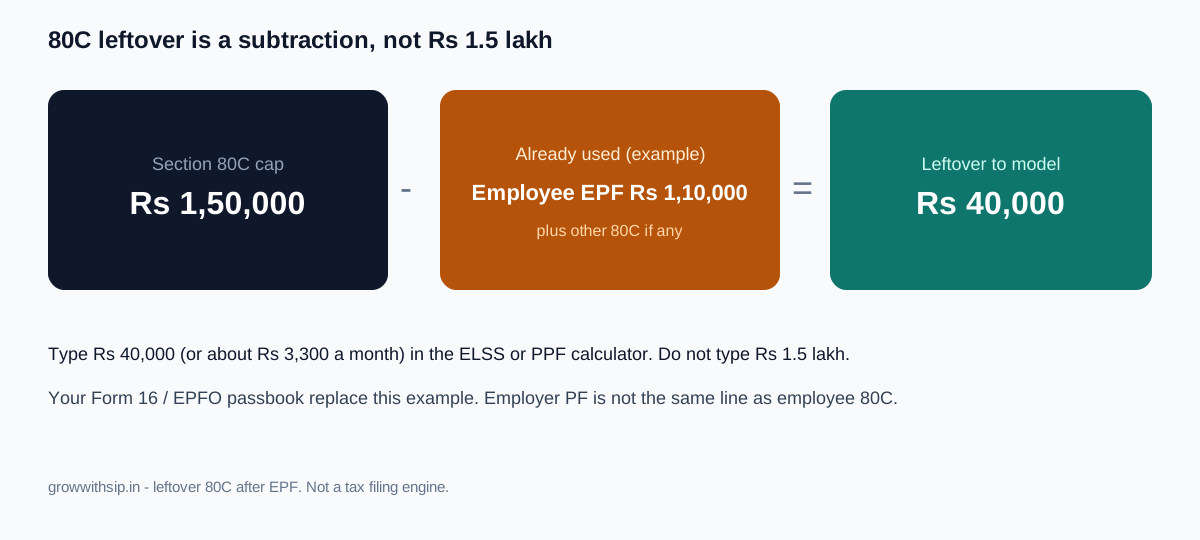
- Tax Savers: Individuals seeking to deduct up to ₹1.5 Lakh from their taxable income under Section 80C.
- Young Earners: Early-career professionals who have a higher risk tolerance and want to build a long-term equity portfolio.
- Wealth Creators: Investors looking to beat inflation over a 5 to 10-year period by gaining equity exposure.
- First-time Equity Investors: The mandatory 3-year lock-in instills investment discipline and prevents panic-selling during temporary market dips.
How the ELSS Calculator Works
The calculator takes simple user inputs to compute complex compounding and tax-saving projections:
- Monthly SIP Amount: The sum you plan to invest regularly every month (e.g., ₹5,000 or ₹12,500).
- Expected Return Rate (p.a.): The annual return rate you expect from the fund (typically 12% to 15% based on long-term equity performance).
- Investment Period (Years): The duration you plan to hold the investment (minimum 3 years, up to 30 years).
Based on these inputs, the calculator outputs the Total Invested, the Estimated Returns, the final Total Value, and the Annual Tax Savings based on a 30% tax slab (capped at ₹45,000/year).
The Mathematics of ELSS Compounding (Formula Section)
The future value of an ELSS investment depends on the mode of investment.
1. Lump Sum Compounding Formula
For a one-time lump-sum investment, the calculator uses the standard compound interest formula:FV = P × (1 + r)^n
Where:
- FV: Future Value (Maturity Value)
- P: Principal investment amount
- r: Expected annual return rate (expressed as a decimal)
- n: Number of years
2. SIP Compounding Formula
For a Systematic Investment Plan (SIP), compounding occurs monthly. The formula used is:FV = P × [((1 + i)^n - 1) / i] × (1 + i)
Where:
- FV: Future Value
- P: Monthly SIP installment
- i: Monthly interest rate (r / 12 / 100)
- n: Total number of months (years × 12)
Step-by-Step Practical Example:
Suppose you start an ELSS SIP of ₹10,000 per month for a period of 3 years (36 months), with an expected return rate of 12% p.a.
- Monthly rate (i) = 12% / 12 = 1% = 0.01
- Total months (n) = 3 × 12 = 36
- Calculation:
FV = 10,000 x [((1.01)^36 - 1) / 0.01] x 1.01FV = 10,000 x [(1.430768 - 1) / 0.01] x 1.01FV = 10,000 x [43.0768] x 1.01 = ₹4,35,076 - Total Invested: ₹3,60,000
- Estimated Returns: ₹75,076
- Total Maturity Value: ₹4,35,076
Real-Life Worked Scenarios: Compounding Pathways
Let us look at how different monthly SIP amounts grow over various periods in an ELSS fund under a 15% annual return assumption:
| Monthly SIP Amount | Tenure (Years) | Total Invested | Estimated Returns | Total Maturity Value | Annual Tax Saved (30% Slab) |
|---|---|---|---|---|---|
| ₹1,000 | 5 Years | ₹60,000 | ₹29,682 | ₹89,682 | ₹3,600 |
| ₹5,000 | 10 Years | ₹6,00,000 | ₹7,93,269 | ₹13,93,269 | ₹18,000 |
| ₹10,000 | 15 Years | ₹18,00,000 | ₹49,86,303 | ₹67,86,303 | ₹36,000 |
| ₹12,500 (Max 80C) | 15 Years | ₹22,50,000 | ₹62,32,878 | ₹84,82,878 | ₹45,000 |
Understanding the ₹12,500 Scenario: By investing ₹12,500 monthly, you exhaust the full ₹1.5 Lakh Section 80C tax deduction limit. Over 15 years, your principal of ₹22.5 Lakh grows to ₹84.82 Lakh, generating ₹62.32 Lakh in returns. Additionally, you save ₹45,000 in income taxes every single year.
Benefits of ELSS Investments
- Shortest Lock-In Period: At just 3 years, ELSS offers the fastest liquidity among all tax-saving instruments (PPF is 15 years, NPS is until age 60, and Tax Saver FDs are 5 years).
- Inflation-Beating Returns: Investing in equity markets gives ELSS the potential to yield much higher returns (historically 12-15%) compared to traditional debt options, aiding long-term wealth creation.
- Rupee Cost Averaging: Setting up a SIP helps buy more units when markets are down, reducing the average cost per unit.
- Professional Management: ELSS funds are managed by expert fund managers who diversify the corpus across multiple sectors.
Limitations of ELSS Investments
- Equity Volatility Risk: Unlike fixed deposits or PPF, returns are not guaranteed. They are subject to stock market fluctuations and can drop in value in the short term.
- Mandatory 3-Year Lock-In: You cannot withdraw your capital under any circumstances before 3 years from the date of investment.
- Capital Gains Tax: While PPF returns are entirely tax-free, ELSS returns are subject to Long-Term Capital Gains (LTCG) tax. Long-term gains above ₹1.25 Lakh per financial year are taxed at 12.5%.
ELSS vs. Other Section 80C Tax-Saving Options
To understand where ELSS fits in your portfolio, compare it with other popular alternatives:
| Feature | ELSS Mutual Funds | Public Provident Fund (PPF) | National Pension System (NPS) | Tax Saver FD |
|---|---|---|---|---|
| Expected Returns | 12% - 15% (Variable) | 7.1% (Fixed, Guaranteed) | 9% - 12% (Variable) | 6.5% - 7.5% (Fixed) |
| Lock-In Period | 3 Years | 15 Years | Until Age 60 | 5 Years |
| Risk Level | Moderate to High | Zero (Govt-backed) | Moderate | Zero (Bank guarantee) |
| Tax on Returns | LTCG at 12.5% (>₹1.25L gains) | Tax-Free (EEE Status) | 60% Lumpsum Tax-Free | Fully Taxable at Slab Rate |
| Best Suited For | Wealth creation & quick lock-in | Guaranteed, risk-free savings | Retirement income planning | Ultra-conservative savers |
Taxation of ELSS: Section 80C and Capital Gains Rules
ELSS tax advantages are twofold:
- Entry Tax Benefit: The amount invested in ELSS (up to ₹1.5 Lakh per year) is deductible from your total gross income under Section 80C. This applies under the Old Tax Regime.
- Exit Tax Rules: Since your holdings are locked for 3 years, all redemptions are subject to Long-Term Capital Gains (LTCG) tax. The first ₹1.25 Lakh of LTCG made across all equity investments in a financial year is tax-free. Gains exceeding ₹1.25 Lakh are taxed at 12.5%. You can check detailed tax slabs and filing rules on tax portals like ClearTax.
Common Mistakes Investors Make with ELSS
- The March Rush: Waiting until the last week of the financial year to invest a lump sum. This exposes you to timing risk. A regular SIP throughout the year is far more effective.
- Redeeming Immediately After 3 Years: Treating the 3-year lock-in as a maturity date. If the fund is performing well, letting your money compound for 5 to 10 years will generate far higher returns.
- Choosing Dividend (IDCW) Option: Selecting the dividend option to bypass the lock-in. Mutual fund dividends are now fully taxable at your income tax slab rate. The growth option is much more tax-efficient.
- Investing in Too Many ELSS Funds: Spreading ₹1.5 Lakh across 5 different ELSS funds. This creates portfolio clutter and duplication. One or two quality ELSS funds are sufficient.
Financial Planning Applications
ELSS fits cleanly into goal-based financial planning:
- Goal-Based Investing: Because of the 3-year lock-in, ELSS is perfect for mid-term goals like buying a car, planning a wedding, or building a house down-payment in 5 years.
- Retirement Planning: Using ELSS to capture equity compounding during your earning years is a great way to grow your retirement corpus before switching to safer assets.
- Child Education Planning: Since higher education costs rise rapidly, ELSS's high returns help build a substantial corpus to meet future college costs.
Retirees who want to withdraw systematic income from their accumulated assets can check projections using our SWP Calculator.