FD Compound Interest Calculator

Calculate compound interest on fixed deposits. Compare cumulative FD maturity for monthly, quarterly, and annual compounding free for Indian banks.

Last reviewed 8 August 2026 · Figures are educational estimates, not bank quotes or advice

Compounding Frequency

Principal Amount

₹1.00L

Compound Interest

₹44,995

Maturity Value

₹1.45L

Smart Insights
Post-tax return (30% slab)
5.25% p.a.
After tax on FD interest income
Real return vs inflation
+1.50%
Assuming 6% p.a. inflation
Daily interest earned
₹25
Average per day over tenure

Year-by-Year Breakdown

YearPrincipalMaturity ValueInterest Earned
1₹1,00,000₹1,07,714₹7,714
2₹1,00,000₹1,16,022₹16,022
3₹1,00,000₹1,24,972₹24,972
4₹1,00,000₹1,34,611₹34,611
5₹1,00,000₹1,44,995₹44,995

What is an FD compound interest calculator?

A fixed deposit locks a lumpsum for a chosen tenure at a declared interest rate. When the FD is cumulative, interest is not paid out every month it is added back to the principal so the next cycle earns interest on a larger balance. That reinvestment is what people mean by compound interest on an FD. This calculator applies the same maths banks use for cumulative deposits and lets you switch compounding frequency so you can compare products that look similar on a rate card but settle differently at maturity.

If you already know your bank’s rate and tenure, use the sliders above first, then read the sections below for tax, premature withdrawal, and when an FD is (or isn’t) the right parking spot for your money.

How to use this calculator

  1. Choose monthly, quarterly, or annual compounding. Most retail bank FDs in India compound quarterly; some special or digital products compound monthly.
  2. Enter the principal you plan to deposit.
  3. Enter the annual interest rate from the bank’s rate card (or the senior-citizen rate if that applies to you).
  4. Set the tenure in years.
  5. Read maturity value, compound interest earned, and the year-by-year table. Export PDF or CSV if you want to share the estimate with family.

Changing only the compounding tab while keeping principal, rate, and tenure fixed is the fastest way to see how much frequency alone is worth on your deposit.

How compound interest on an FD is calculated

Cumulative FDs use the standard compound interest formula. Interest is calculated on the outstanding balance at each compounding date and added to principal:

A = P × (1 + r/n)n×t
  • A — amount at maturity
  • P — principal you deposit
  • r — annual rate as a decimal (7.5% → 0.075)
  • n — compounding cycles per year (12, 4, or 1)
  • t — tenure in years

Compound interest earned is simply A − P. Non-cumulative FDs that pay interest out to your savings account do not use this growth path for the payout stream; those payouts are closer to simple interest on the original principal. This page models the cumulative case, which is what most people mean when they search for an FD compound interest calculator.

Monthly vs quarterly vs annual compounding

The headline rate can be identical and the maturity still differ slightly because n changes how often interest is capitalised. Same deposit, same rate, same years only frequency changes. Example: ₹1,00,000 at 7.5% p.a. for 5 years:

CompoundingInterest earnedMaturity value
Monthly₹45,329₹1,45,329
Quarterly (typical bank FD)₹44,995₹1,44,995
Annually₹43,563₹1,43,563

The gap is modest on short tenures and widens as years increase. Open the same scenario with shareable links: monthly, quarterly, or annual compounding.

Cumulative FD vs interest-payout FD

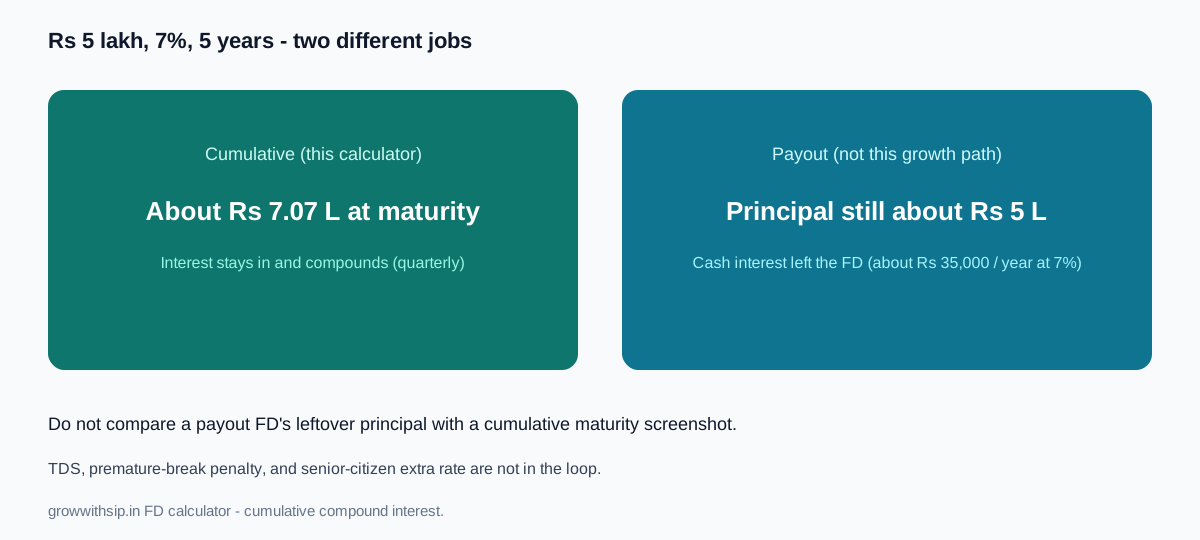
Banks usually offer two payout styles. A cumulative FD reinvests interest and pays one maturity amount best when you do not need cash flow during the tenure. An interest-payout (non-cumulative) FD credits interest to your account monthly, quarterly, or annually; the principal stays put and you give up compounding on that interest. Choose cumulative when the goal is maximum corpus; choose payout when the FD is meant to supplement monthly expenses.

Worked example: ₹5 lakh for 5 years

Suppose you deposit ₹5,00,000 for 5 years at 7% p.a. with quarterly compounding. Maturity lands near ₹7.07 lakh, so compound interest is roughly ₹2.07 lakh before tax. Run it yourself: ₹5L at 7% for 5 years with quarterly. If you are in the 30% slab, remember that interest is taxed as income, the post-tax yield is meaningfully lower than the rate on the brochure.

Tax on FD interest in India

Interest from bank and most other FDs is added to your total income and taxed at your slab rate. Banks may deduct TDS when interest in a financial year crosses the threshold (commonly ₹40,000 for individuals below 60, and a higher limit for senior citizens confirm the current rule when you file). TDS is not the final tax; if your slab is higher, you may owe more at return time, and if it is lower you can claim a refund. For planning, the “post-tax return” insight above assumes a 30% slab as a conservative stress test - adjust mentally for your own slab.

Premature withdrawal and laddering

Breaking an FD early usually attracts a penalty, often a 0.5% to 1% reduction on the applicable rate for the period the deposit actually ran. Before you break, re-run this calculator with the reduced rate and shorter tenure so you know the real cost.

Laddering spreads one corpus across several FDs with staggered maturities (for example 1, 2, 3, and 5 years). Each year something matures, which improves liquidity and reduces the risk of renewing everything when rates are unfavourable. Recalculate each rung when you renew so the plan stays honest.

Deposit insurance (DICGC)

Bank deposits, including FDs, are insured by DICGC up to ₹5 lakh per depositor per bank (principal and interest combined, subject to current scheme rules). That cover is a reason many households still prefer bank FDs for emergency and near-term money, even when post-tax yields look modest next to market-linked products.

Indicative FD rates (major banks)

Rate cards move with RBI policy and each bank’s liability needs. Treat the table as a starting point, then type the exact offer into the calculator:

Bank1 Year3 Years5 Years
SBI6.8%7.0%6.5%
HDFC Bank6.6%7.25%7.0%
ICICI Bank6.7%7.2%7.0%
Axis Bank6.7%7.25%7.0%
Post Office6.9%7.1%7.5%

* Indicative only. Senior citizens typically receive a small premium. Always verify the live rate and compounding frequency on the bank’s site before booking.

When an FD makes sense and when it does not

FDs fit money you cannot afford to see fall in value: emergency buffers beyond your savings account, school fees due in two or three years, or a home down-payment you will need on a fixed date. They are weaker as the sole long-term wealth engine because inflation and tax can leave little real growth. For horizons of seven years or more where you can tolerate volatility, many investors compare FDs with equity SIPs, see our SIP vs FD guide. If you save monthly rather than in one lumpsum, model a recurring deposit instead.

Common mistakes to avoid

  • Comparing two FDs on rate alone without checking compounding frequency.
  • Ignoring tax and celebrating the pre-tax maturity number.
  • Locking the entire emergency fund in a five-year FD with heavy break penalties.
  • Auto-renewing without checking whether better tenures or banks are available.

Methodology note

Results use A = P × (1 + r/n)n×t with n = 12 (monthly), 4 (quarterly), or 1 (annual). Day-count conventions and TDS timing can make a bank’s passbook differ by a small amount from this estimate. Always treat the output as a planning figure and confirm final maturity with the bank’s deposit advice.

Frequently Asked Questions

Related Calculators