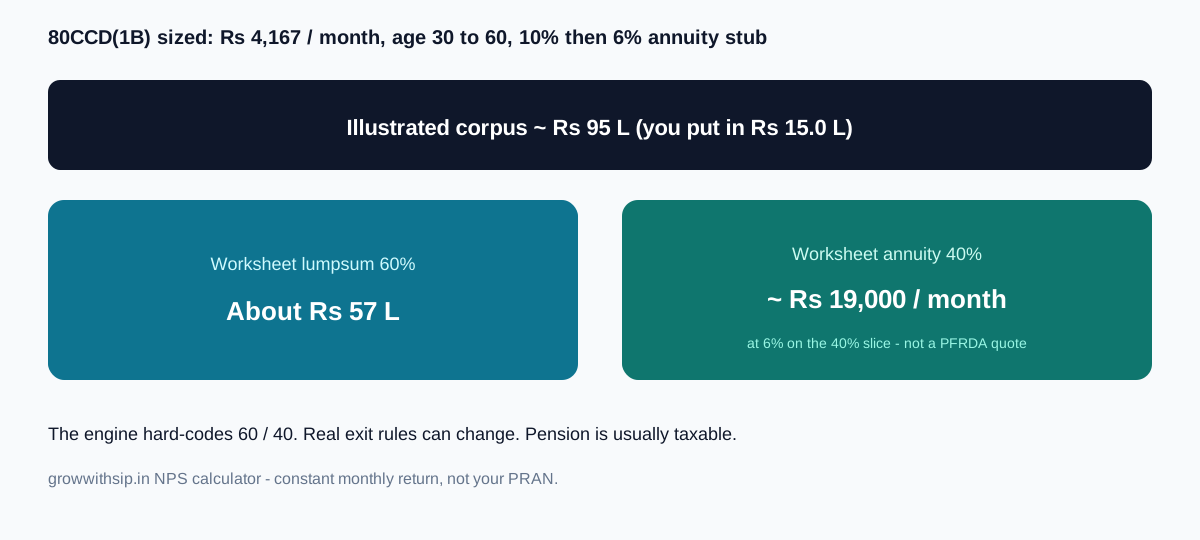
Why Use an NPS Calculator with Pension and Lumpsum Projections?
Planning for life after retirement requires a clear understanding of how much wealth you will accumulate and what your monthly salary replacement will look like. Our free, online NPS Calculator with Pension and Lumpsum Projections allows you to calculate these figures instantly. The National Pension System is regulated by the PFRDA and monitored under the NPS Trust guidelines for secure retirement planning.
By inputting your monthly contributions, current age, expected return rate, and annuity details, the NPS Calculator with Pension and Lumpsum Projections maps out your compound growth over the decades. It then breaks down your retirement corpus into the tax-free lumpsum payout and the required annuity portion, providing a reliable baseline for retirement income planning.
Who Should Consider the National Pension System (NPS)?
NPS is an excellent addition to your financial plan if you are:
- Salaried Employees: Professionals seeking to maximize tax savings under Section 80CCD(1B) and Section 80CCD(2) on top of Section 80C.
- Self-Employed Professionals: Business owners looking to build a structured, low-cost retirement fund.
- Long-Term retirement planning Seekers: Investors seeking a disciplined lock-in that ensures their retirement pool remains untouched until age 60.
- Balanced Investors: Savers who want dynamic, low-cost market exposure across both equities and corporate debt.
NPS Tier I vs. Tier II Accounts: Key Differences
When you open an NPS account, you can activate two types of sub-accounts:
- NPS Tier I (Primary Account): This is the mandatory pension account. It offers all the tax-saving benefits but has a lock-in until age 60. Withdrawals before 60 are strictly limited.
- NPS Tier II (Voluntary Account): This is a voluntary investment account with complete liquidity. You can withdraw your money anytime without penalties. However, Tier II accounts do not offer tax deductions.
How the NPS Calculator Works
The calculator takes simple inputs to forecast your retirement income:
- Monthly Contribution: The amount you invest in your Tier I account monthly.
- Current Age: Your current age (minimum 18, maximum 65).
- Retirement Age: The age at which you plan to exit (usually 60, extendable up to 70).
- Expected Return Rate: The expected annual return rate on your portfolio (typically 9% to 12% based on equity and bond ratios).
- Annuity Rate: The annual yield you expect on your annuity corpus after retirement (typically 5.5% to 7%).
The Mathematics of NPS Compounding (Formula Section)
The NPS retirement corpus accumulates through monthly compounding contributions. The future value (FV) is computed using the monthly compounding formula:FV = P × [((1 + i)^n - 1) / i] × (1 + i)
Where:
- P: Monthly contribution
- i: Monthly expected rate of return (Expected Return Rate / 12 / 100)
- n: Total number of compounding months (years to retirement × 12)
Retirement Corpus Splits and Pension Calculations:
Upon reaching age 60, the maturity corpus (C) is split:Lumpsum Payout (60%) = C × 0.60 (completely tax-free)Annuity Corpus (40%) = C × 0.40 (mandatory purchase)
The annual pension income is generated from the annuity pool:Annual Pension = Annuity Corpus × Annuity RateMonthly Pension = Annual Pension / 12
Step-by-Step NPS Compounding Example:
Suppose a 30-year-old investor contributes ₹10,000 per month to NPS Tier I. They plan to retire at 60 (30 years of accumulation), expecting a 10% p.a. expected return rate and a 6% annuity rate.
- Monthly rate (i) = 10% / 12 = 0.833% = 0.008333
- Total months (n) = 30 × 12 = 360
- Calculation:
FV = 10,000 × [((1.008333)^360 - 1) / 0.008333] × 1.008333FV = ₹2.27 Crore - Total Invested: ₹36 Lakh
- Total Accumulated Corpus: ₹2.27 Crore
- Tax-Free Lumpsum (60%): ₹1.36 Crore
- Annuity Corpus (40%): ₹90.8 Lakh
- Monthly Pension: (₹90.8 Lakh × 6%) / 12 = ₹45,400 per month
Real-Life Worked Scenarios: Retirement Income Planning
Let us look at how different monthly contribution amounts grow from different starting ages until retirement at age 60 under a 10% return rate and a 6% annuity rate:
| Monthly Contribution | Starting Age | Total Invested | Total Corpus at 60 | 60% Lumpsum Payout | Monthly Pension |
|---|---|---|---|---|---|
| ₹5,000 | 25 Years | ₹21.00 Lakh | ₹1.91 Crore | ₹1.14 Crore | ₹38,137 |
| ₹10,000 | 35 Years | ₹30.00 Lakh | ₹1.33 Crore | ₹80.2 Lakh | ₹26,734 |
| ₹15,000 | 40 Years | ₹36.00 Lakh | ₹1.14 Crore | ₹68.3 Lakh | ₹22,780 |
| ₹25,000 | 30 Years | ₹90.00 Lakh | ₹5.69 Crore | ₹3.41 Crore | ₹1,13,878 |
The Cost of Delay: Notice that investing ₹5,000/month starting at age 25 yields a higher retirement corpus (₹1.91 Crore) than investing ₹15,000/month starting at age 40 (₹1.14 Crore), illustrating the massive impact of compounding duration.
Understanding Asset Allocation in NPS: E, C, G, and A
NPS investments are distributed across four asset classes:
- Equity (Asset Class E): Invests in equity stocks. Highly volatile, but offers the highest long-term returns.
- Corporate Debt (Asset Class C): Invests in corporate bonds and fixed-income assets. Offers moderate returns and stability.
- Government Securities (Asset Class G): Invests in central and state government gilts. Safest asset class, yielding stable returns.
- Alternative Assets (Asset Class A): Invests in REITs, InvITs, and alternative assets. Highly restricted, capped at a maximum of 5%.
NPS vs. Alternative Retirement Savings Plans
Compare NPS with other long-term retirement accounts:
| Feature | NPS (Tier I) | EPF | PPF | Retirement Mutual Funds |
|---|---|---|---|---|
| Asset Mix | Equity & Debt (Market-linked) | Strict Debt (Sovereign) | Strict Debt (Sovereign) | Equity & Debt (Market-linked) |
| Section 80C Deduction | Eligible (Up to ₹1.5L) | Eligible (Up to ₹1.5L) | Eligible (Up to ₹1.5L) | Not Eligible (Except ELSS) |
| Exclusive Deduction | ₹50,000 under 80CCD(1B) | None | None | None |
| Exit on Maturity | 60% Lump Sum + 40% Annuity | 100% Lump Sum | 100% Lump Sum | 100% Lump Sum |
Taxation of NPS: A Guide to Deductions and Exemptions
The tax benefits under NPS Tier I are highly attractive:
- Section 80CCD(1): Your self-contributions (up to 10% of salary) are deductible, up to the overall Section 80C limit of ₹1.5 Lakh.
- Section 80CCD(1B): An exclusive additional deduction of up to ₹50,000 is allowed for Tier I contributions. This is independent of the 80C limit.
- Section 80CCD(2): Employer contributions to your NPS account are deductible up to 10% of salary (14% for government employees) without any upper ceiling.
- Maturity Payout Tax: The 60% lump sum withdrawal at age 60 is completely tax-free. The 40% annuity purchase is also tax-exempt, but the subsequent monthly pension payouts are taxed as per your slab rate. You can check detailed slab computations and file declarations using ClearTax.
Common Mistakes NPS Investors Make
- Choosing a very conservative asset allocation when young: Selecting 100% Government Securities at age 25. This drastically limits your compounding potential.
- Underestimating the Annuity Requirement: Forgetting that 40% of the corpus must be annuitized at age 60, meaning it cannot be withdrawn as a cash lump sum.
- Ignoring Fund Manager Performance: Not reviewing the performance of your chosen fund manager. You can switch fund managers once a year if their returns lag behind peers.
- Not utilizing Section 80CCD(1B): Failing to claim the extra ₹50,000 deduction, which saves up to ₹15,600 in taxes annually.
Financial Planning Applications
NPS serves as the foundation for your post-retirement life:
- Retirement Planning: NPS provides a disciplined retirement structure by combining high equity compounding during your career with a guaranteed annuity pension stream in old age.
- Goal-Based Wealth Preservation: The strict lock-in ensures that you do not touch your retirement assets to fund short-term lifestyle expenses.
Retirees who want to withdraw systematic income from an accumulated mutual fund portfolio can check payout parameters using our SWP Calculator.