PPF Calculator - Maturity & Interest

Estimate your guaranteed maturity corpus using our free PPF interest rate calculator. See the annual interest compounding schedule for your 15-year account.

Last reviewed 8 August 2026 · Figures are educational estimates, not bank quotes or advice

Current PPF Interest Rate

7.1% p.a.

Compounded annually. Tax-free returns under Section 10(11).

Total Invested

₹22.50L

Interest Earned

₹18.18L

Maturity Value

₹40.68L

Corpus Growth Over Time

Smart Insights
Annual tax saved (30% slab)
₹45,000
Under Section 80C
Total tax benefit
₹6.75L
Over 15 years (EEE benefit)
Effective post-tax return
>7.1% p.a.
Tax-free = higher effective yield

Year-by-Year Breakdown

YearTotal InvestedInterest EarnedBalance
1₹1,50,000₹10,650₹1,60,650
2₹3,00,000₹32,706₹3,32,706
3₹4,50,000₹66,978₹5,16,978
4₹6,00,000₹1,14,334₹7,14,334
5₹7,50,000₹1,75,701₹9,25,701
6₹9,00,000₹2,52,076₹11,52,076
7₹10,50,000₹3,44,524₹13,94,524
8₹12,00,000₹4,54,185₹16,54,185
9₹13,50,000₹5,82,282₹19,32,282
10₹15,00,000₹7,30,124₹22,30,124
Showing 10 of 15 years —

Why Use a PPF Interest Rate Calculator?

The Public Provident Fund (PPF) is one of India's most popular long-term savings options, prized for its tax-free guaranteed returns. However, because PPF interest compounding occurs annually, the timing and consistency of your deposits greatly influence your final wealth. You can check detailed tax slabs and filing rules on tax portals like ClearTax.

By using our online ppf interest rate calculator, you can calculate the exact trajectory of your savings year by year. This specialized ppf interest rate calculator helps you map out your annual contributions, interest earned, and the compounding balance over the mandatory 15-year tenure. If you want to check long-term projections, our ppf maturity calculator and ppf interest calculator show you the compounding outcomes for extensions of up to 50 years.

Who Should Consider PPF?

PPF is highly recommended for:

  • Risk-Averse Savers: Individuals seeking 100% capital safety backed by the Government of India.
  • Self-Employed Professionals: Since they do not have access to EPF, PPF serves as an excellent retirement buffer.
  • Conservative Long-Term Wealth Builders: Investors seeking a stable debt component for their financial portfolio.
  • High-Net-Worth Individuals (HNIs): Tax planning savers who want to park up to ₹1.5 Lakh annually in a completely tax-free asset.

You can open a PPF account at any authorized commercial bank, such as HDFC Bank or the State Bank of India (SBI), or at any post office branch.

How the PPF Calculator Works

The calculator uses the central government's declared interest rate (currently 7.1% p.a.) and compounding logic to estimate your future maturity pool. The inputs are:

  • Yearly Investment: The amount you invest in a financial year (ranging from ₹500 to ₹1,50,000).
  • Investment Period: The tenure of the account, starting at the mandatory 15 years, extendable up to 50 years.

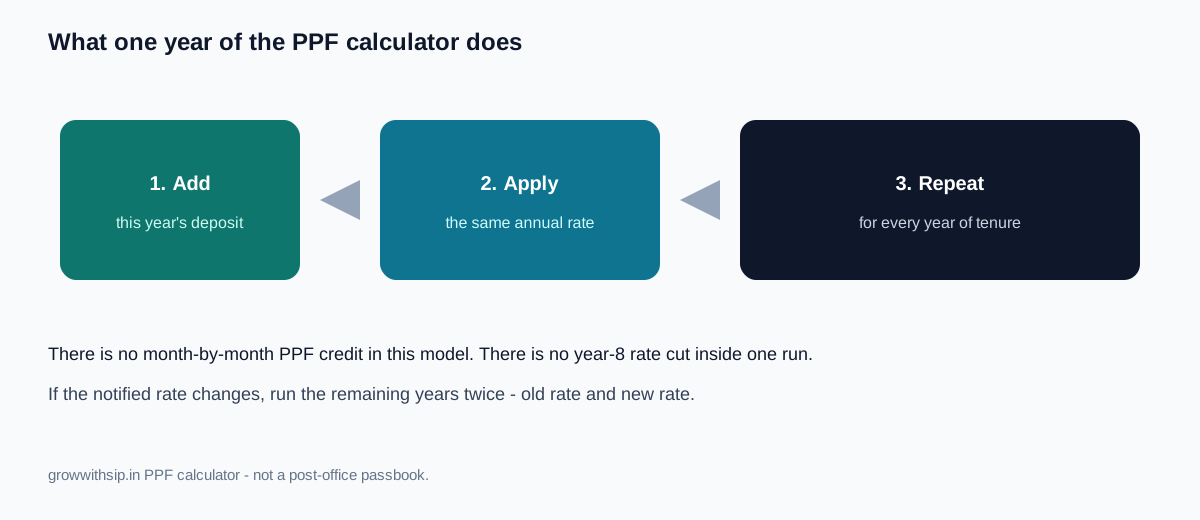
Based on these parameters, the tool displays the Total Invested Amount, the Interest Earned, and the final Maturity Value. It also generates a detailed year-by-year schedule showing the compounding interest and balance.

The Mathematics of PPF Compounding (Formula Section)

Since PPF contributions are compounded annually, the maturity value is computed using the following formula:
FV = P × [((1 + r)^n - 1) / r]

Where:

  • FV: Future Value (Maturity Value)
  • P: Annual contribution (deposited at the start of the financial year)
  • r: Annual interest rate (currently 7.1% or 0.071)
  • n: Total number of years (minimum 15)

The Monthly Interest Calculation Methodology:

While compounding occurs annually, the interest is calculated monthly using the 5th of the Month Rule:
Monthly Interest = Lowest Balance between the 5th and the last day of the month × (Annual Rate / 12)

At the end of the financial year (March 31st), the monthly interest calculated for all 12 months is summed up and credited to the principal balance, which then compounds for the next year.

Step-by-Step Compounding Example:

Suppose you deposit ₹1,50,000 annually at the start of every year (on or before April 5th) for 15 years at an interest rate of 7.1% p.a.

  • Year 1: Principal = ₹1,50,000. Interest earned = ₹1,50,000 × 7.1% = ₹10,650. Year-end balance = ₹1,60,650.
  • Year 2: Opening balance = ₹1,60,650. Fresh contribution = ₹1,50,000. Total compounding principal = ₹3,10,650. Interest earned = ₹3,10,650 × 7.1% = ₹22,056. Year-end balance = ₹3,32,706.
  • Continuing this compounding process until Year 15:
    FV = 1,50,000 × [((1.071)^15 - 1) / 0.071]
    FV = 1,50,000 × [(2.7831 - 1) / 0.071]
    FV = 1,50,000 × [25.1143] = ₹37,67,143
  • Total Invested: ₹22,50,000
  • Interest Earned: ₹15,17,143
  • Total Maturity Value: ₹37,67,143

Real-Life Worked Scenarios: Compounding Pathways

Let us look at how different annual contribution amounts grow over various periods in a PPF account at a constant 7.1% p.a. interest rate:

Annual DepositTenure (Years)Total InvestedTotal Interest EarnedMaturity ValueTotal Tax Saved (30% Slab)
₹10,00015 Years₹1,50,000₹1,01,143₹2,51,143₹45,000
₹50,00020 Years₹10,00,000₹11,31,524₹21,31,524₹3,00,000
₹1,00,00025 Years₹25,00,000₹40,88,574₹65,88,574₹7,50,000
₹1,50,00030 Years₹45,00,000₹90,26,456₹1,35,26,456₹13,50,000

The Compounding Crossover: In the 30-year scenario, your total interest earned (₹90.26 Lakh) is double your invested capital (₹45 Lakh), demonstrating the explosive power of long-term compounding when you utilize 5-year extension blocks.

PPF Account Rules, Extensions, and Liquidity

1. Annual Contribution Limits

You must invest a minimum of ₹500 per year to keep your PPF account active. The maximum limit is ₹1.5 Lakh per year. If you fail to invest the minimum ₹500, a penalty of ₹50 per dormant year plus the minimum deposit of ₹500 is required to reactivate the account.

2. Extension Options After Maturity

Once your PPF account matures after 15 years, you have two extension choices:

  • Extension with Contributions: Submit Form H within 1 year of maturity to continue depositing. You can extend in blocks of 5 years indefinitely.
  • Extension without Contributions: Default option. Your existing corpus continues to earn interest, and you can withdraw up to 100% of the balance once a year.

3. Loan and Partial Withdrawal Rules

PPF balances can be used for liquidity before maturity:

  • Loan against PPF: Available from the 3rd to the 6th financial year. You can borrow up to 25% of the balance at the end of the 2nd preceding year. Interest on the loan is PPF interest rate + 1% p.a.
  • Partial Withdrawals: Allowed from the 7th financial year. You can withdraw up to 50% of the balance at the end of the 4th preceding year or the end of the previous year, whichever is lower.

PPF vs. Alternative Debt and Savings Investments

To understand the advantages of PPF, compare it with other retirement and savings options:

FeaturePPFEPF (Salaried)Bank FDDebt Mutual Funds
Interest Rate7.1% (Fixed, Tax-Free)8.15% - 8.25% (Variable)6.5% - 7.5% (Fixed)6.5% - 8.0% (Variable)
Lock-In Period15 YearsUntil Retirement7 Days to 10 YearsNone (Open-ended)
Tax TreatmentEEE (Exempt-Exempt-Exempt)EEE (Exempt up to ₹2.5L/yr)Taxed at slab rate annuallyTaxed at slab rate on exit
Capital SafetySovereign GuaranteeSovereign GuaranteeDICGC cover up to ₹5LMarket-linked debt risk

Common Mistakes PPF Investors Make

  • Depositing after the 5th of the month: Making monthly deposits on the 10th or 15th. This costs you a full month's interest. Ensure your funds clear by the 4th of each month.
  • Investing more than ₹1.5 Lakh: Putting excess money into PPF. The excess amount earns 0% interest and receives no tax benefits.
  • Forgetting to Submit Form H: Continuing to make deposits after Year 15 without submitting Form H. These deposits do not earn interest and are not eligible for Section 80C deductions.
  • Keeping the Account Dormant: Forgetting to deposit the minimum ₹500, leading to a dormant account and losing withdrawal privileges.

Financial Planning Applications

PPF is an excellent asset protection and long-term retirement tool:

  • Retirement Planning: Due to its EEE tax status, PPF builds a completely tax-free debt corpus that balances out risky equity investments.
  • Asset Protection: Under the PPF Act, your PPF balance is safe from creditors and court attachments, making it a secure nest egg.
  • Child's Higher Education/Marriage: Opening a PPF account for a minor when they are 5 years old ensures that a tax-free corpus matures right when they turn 20 and need university funding.

To estimate the retirement pool size you require to beat long-term price rises, use our Retirement Calculator or see how goals are tracked in our Goal Planner.

Frequently Asked Questions

Related Calculators