
Open a mutual fund order and you will usually see two dates. One is when you placed the order or when the SIP amount left your bank. The other is the NAV date. That second date is the one that decides the price used to allot or redeem your units.
People mix them up because apps show a live-looking number. The number on the screen is yesterday’s published price, or the last business day’s price. Your order is filled at a price that does not exist yet.
What NAV means
NAV is net asset value. It is the price of one unit of a mutual fund scheme on a given day. The fund adds up what it holds, subtracts what it owes, and divides by the number of units. Equity schemes, debt schemes, and hybrid schemes each have their own NAV. A fund house can run many schemes, so “the fund’s NAV” is not one number for the whole company.
AMFI publishes scheme NAVs for investors to check. Your registrar statement (CAMS or KFintech, for most retail folios) is the record of which NAV was used for your own transaction.
What the NAV date is
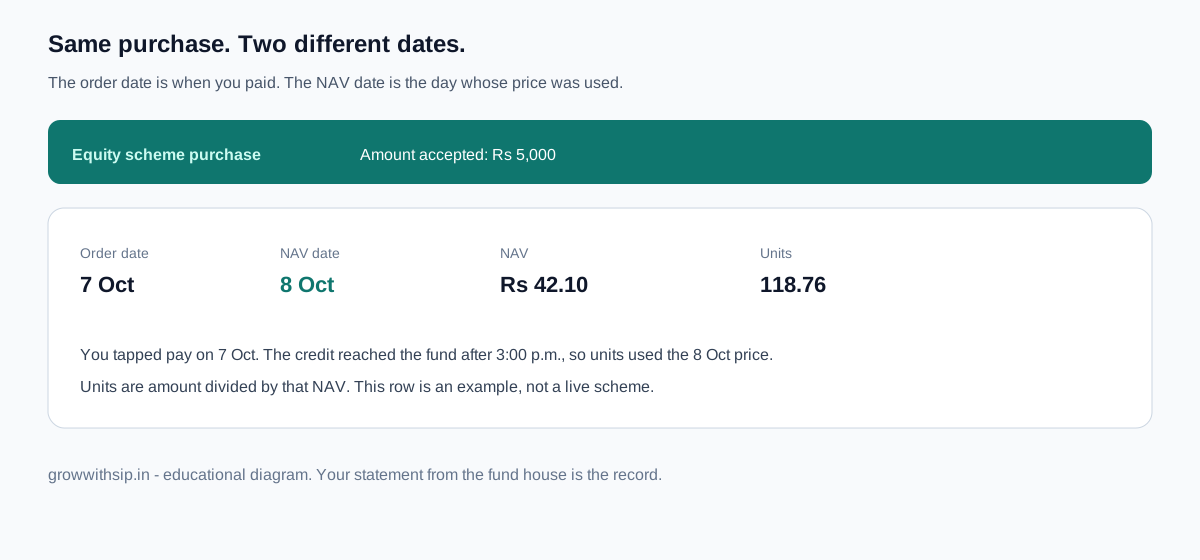
The NAV date is the business day that price belongs to. If your statement says NAV date 8 October and NAV ₹42.10, each unit you bought or sold was priced at ₹42.10, the value calculated for 8 October.
Units for a purchase are roughly the rupees accepted, divided by that NAV. A ₹5,000 purchase at ₹42.10 is about 118.76 units, before any stamp duty on the purchase. The NAV date is what makes that division possible. Without it, “NAV ₹42.10” could be any day in the fund’s history.

The price you see is not the price you get
Mutual funds in India use forward pricing. You do not buy at the last NAV already printed on the app. The fund works out today’s NAV after the markets and the scheme’s holdings are valued, then publishes it. Your order is tagged to a NAV date first. The rupee price for that date shows up later, often the same evening or the next morning.
That is why refreshing the app at 2 p.m. does not tell you your purchase price. It tells you the last declared NAV. The applicable NAV is decided by the cut-off rules, not by the number on the screen when you tap buy.
Cut-off time and when the money arrives
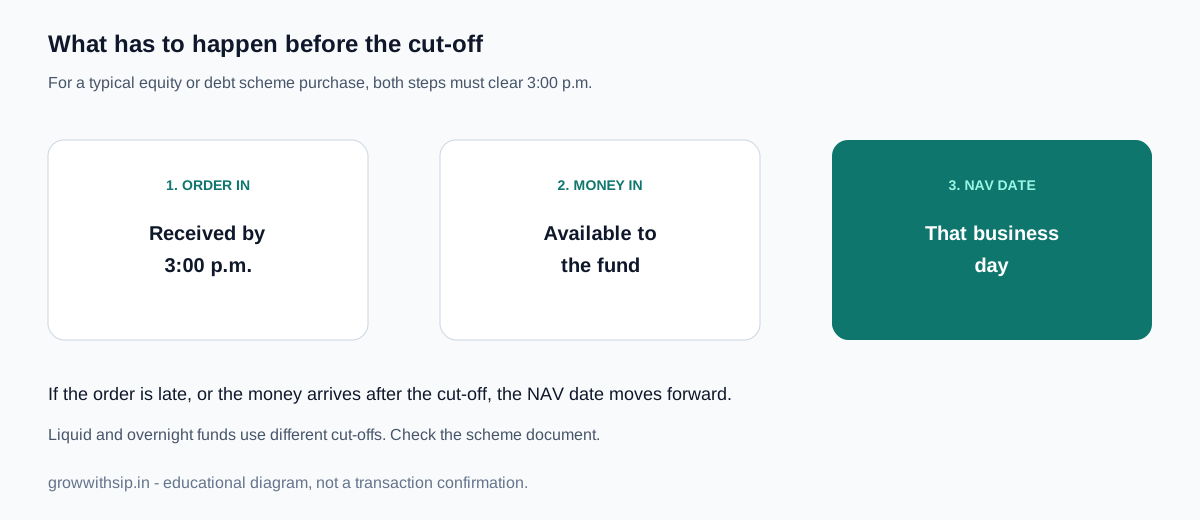
For most schemes that are not liquid or overnight funds, the purchase cut-off is 3:00 p.m. on a business day. Same-day NAV applies only if two things are both true: the purchase is received by 3:00 p.m. at an official point of acceptance, and the full amount is available for the fund to use by 3:00 p.m. that same day.
If the order is in time but the money arrives after 3:00 p.m., the NAV date moves. It becomes the later business day on which the money is available before the cut-off. If you place the order after 3:00 p.m., you do not get that day’s NAV even if the money was already in the fund’s account. AMFI’s note on NAV applicability summarises this from SEBI circulars dated 17 September 2020 and 31 December 2020, in force for purchases from 1 February 2021. Read the current SEBI circular if you are checking a large purchase, because cut-off rules for some scheme types have been updated since then.
| Order received | Money available to the fund | NAV date for the purchase |
|---|---|---|
| By 3:00 p.m. on a business day | By 3:00 p.m. the same day | That business day |
| By 3:00 p.m. | After 3:00 p.m., or on a later day | The later business day when the money is available before 3:00 p.m. |
| After 3:00 p.m. | Same day or later | The next business day on which the money is available before the cut-off |
This table is the usual rule for purchases in schemes other than liquid and overnight funds. It is not a promise that your UPI payment at 2:55 p.m. will clear in time. Banks, payment aggregators, and the fund’s collection account all sit in the path. The confirmation from the fund house is the NAV date that counts.

A weekday example
Suppose Wednesday is a normal business day and you buy units in an equity scheme. You submit the order at 11:00 a.m. and the full amount is available to the fund before 3:00 p.m. The NAV date should be Wednesday. You will not know Wednesday’s NAV at 11:00 a.m. It is declared after valuation.
Now suppose the same order is submitted at 11:00 a.m., but the bank credit reaches the fund only on Thursday morning. Wednesday’s cut-off was missed on the money leg. The NAV date moves to Thursday, if Thursday is a business day and the money is available before 3:00 p.m. The app may still show Wednesday as the day you tapped pay. That is the transaction date, not the NAV date.
Weekends, holidays, and a SIP that did not go through
Mutual fund NAVs are tied to business days. Saturday, Sunday, and market holidays are not business days for this purpose. An order placed on Saturday does not get a Saturday NAV. It waits for the next business day, and it still has to meet that day’s cut-off and, for a purchase, the fund-availability rule.
A SIP adds one more date: the debit date. That is the day your bank is asked for the instalment. If the debit succeeds and the money is available before the cut-off, the NAV date is often the same business day, or the next one if the mandate runs late in the day. If the debit fails, there is no NAV date for that instalment until a successful retry. Units are not allotted for a bounced debit.
This is also why two people with the same SIP date can see different NAV dates in the same month. One bank posted the credit before 3:00 p.m. The other posted it after. The SIP calculator cannot see that. It assumes every instalment happens on schedule at the return you type.
Selling units
A redemption does not wait for money to “reach” the fund. You already hold the units. For most schemes the cut-off is still 3:00 p.m. A redemption request received by 3:00 p.m. on a business day is priced at that day’s NAV. A request received after 3:00 p.m. uses the next business day’s NAV. The payout to your bank comes later. The credit date in your bank account is not the NAV date.
A switch is a redemption in one scheme and a purchase in another. The two legs can have different NAV dates if the purchase leg is waiting for the money from the first scheme. Check both lines on the statement instead of assuming one date covers the switch.
Liquid and overnight funds
Liquid funds and overnight funds do not follow the same 3:00 p.m. purchase rule as an equity SIP. Their cut-off is earlier, and the NAV applied is often the previous business day’s NAV when the order and the money both meet that earlier cut-off. Overnight-fund redemptions also have a separate online cut-off in a later SEBI circular. The scheme information document states the cut-off the fund house is using. If you are moving cash for a day or two, read that document rather than copying the equity-fund table above.
Does a higher or lower NAV change your return?
No. A higher NAV is not “expensive,” and a lower NAV is not “cheap.” NAV is only the price of one unit on that date. The fund’s return is the percentage change in that price, not the rupee level of the NAV.
You invest rupees, not a fixed number of units. A higher NAV simply means your money buys fewer units. A lower NAV means it buys more units. If both schemes then move by the same percentage, the rupee value of your investment moves by that same percentage.
Take ₹10,000 invested on the same day in two schemes that both rise 20% by the next date you check. The NAVs below are examples, not live scheme prices.
| Lower NAV | Higher NAV | |
|---|---|---|
| NAV on the purchase date | ₹10 | ₹200 |
| Amount invested | ₹10,000 | ₹10,000 |
| Units allotted | 1,000 | 50 |
| NAV after a 20% rise | ₹12 | ₹240 |
| Value of the holding | ₹12,000 | ₹12,000 |
Both holdings are worth ₹12,000. The scheme that started at ₹10 did not “have more room to grow.” The scheme at ₹200 did not “already use up” its growth. Each one rose 20%, so ₹10,000 became ₹12,000 in both cases.
The same arithmetic works when the NAV falls. If both NAVs drop 10%, ₹10 becomes ₹9 and ₹200 becomes ₹180. The first holding is 1,000 × ₹9 = ₹9,000. The second is 50 × ₹180 = ₹9,000. A lower starting NAV did not protect the money. A higher starting NAV did not make the loss worse.
New schemes often open at ₹10. That figure is a starting unit price chosen by the fund house. It is not a discount to an older scheme whose NAV is ₹80 or ₹400 because that scheme has been running for years. Those two NAVs cannot be compared with each other. The portfolios, the dates, and the costs are different. Compare the percentage change between two NAV dates of the same scheme, or the published return of each scheme over the same period.
What these calculators leave out
A NAV date tells you which day’s unit price was used. It does not tell you what the scheme will be worth in ten years. The lumpsum calculator and the SIP calculator compound one rate you choose. They never download a NAV, and they never split your rupees into units. The SIP versus lumpsum note is about when the cash is invested, not about which day’s NAV a fund house will allot.
If you already have a start value and an end value from your statement, the CAGR calculator only measures the rate that connects those two numbers. It does not look up the NAV dates in between.
Where to confirm the number
Use three places, in this order. The allotment email or the account statement shows the NAV date applied to you. AMFI’s NAV page shows the declared NAV for the scheme on a date. The scheme document and the latest SEBI circular tell you the cut-off rule. If the app and the statement disagree, trust the statement from the fund house or the registrar.
Rules and cut-off times can change. Check the latest SEBI circular or the scheme document before you rely on a cut-off for a payment you cannot afford to have priced a day later.