
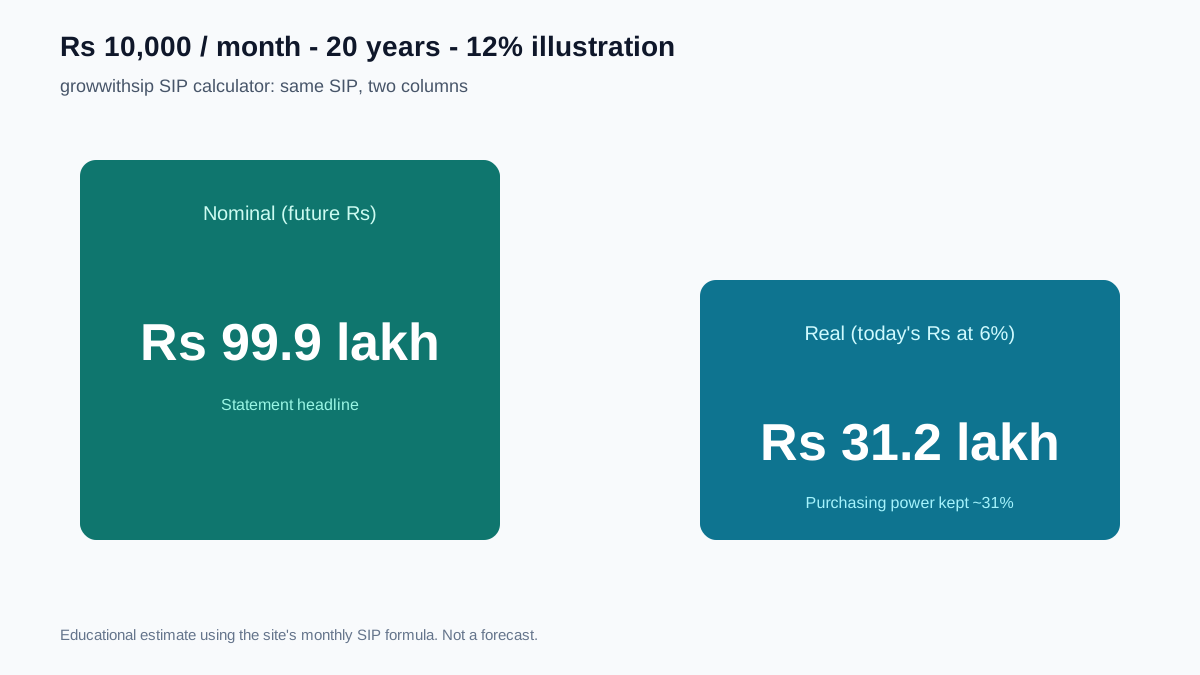
I did not add inflation to these tools as a marketing badge. I added it because the first number people screenshot - “₹99.9 lakh after 20 years” is the number that most often lies. It is true in future rupees. It is not true in the rupees you use to pay rent, fees, and hospital bills today. This page is the method note for how growwithsip turns one into the other, and where it refuses to pretend.


What the page actually computes
On the SIP calculator, the engine first compounds monthly at the expected-return slider (the ordinary future value of an annuity due). That is the nominal corpus. Separately, an inflation factor (1 + i)n is applied to that terminal value to print a real value in today’s rupees. Year-by-year rows use the same idea at each year, not only at maturity.
Goal targeting inflates the goal first, then solves for the SIP that funds the inflated amount. That is why a ₹1 crore “today” goal needs a larger monthly debit than a ₹1 crore “future” goal you typed already grown. If you mix the two methods you double-count. That trap has its own note.
I use a constant i. Markets do not. CPI in India has printed near 2% and near 8% in different years. Healthcare and school fees often run hotter than headline CPI. If your actual basket inflates at 8%, type 8%. Do not leave 6% because it is the default.
A worked SIP: the gap you screenshot
Leave ₹10,000 a month, 12% assumed return, 20 years, 6% inflation on the SIP page. You contribute ₹24 lakh of your own money. Nominal maturity is about ₹99.9 lakh. Real value is about ₹31.2 lakh of today’s goods, roughly 31% of the headline. Move inflation to 8%. The nominal column does not move. The real column does. That is the demonstration I wanted when other sites only advertised the crore.

At 6% inflation, ₹1 crore after 25 years is about ₹23.3 lakh in today’s rupees. After 25 years at 8% (a common education/healthcare stub) it is closer to ₹14.6 lakh. Use the SIP page’s “value of 1 crore” table if you want other horizons without inventing a new formula.
Fisher, not “12 minus 6”
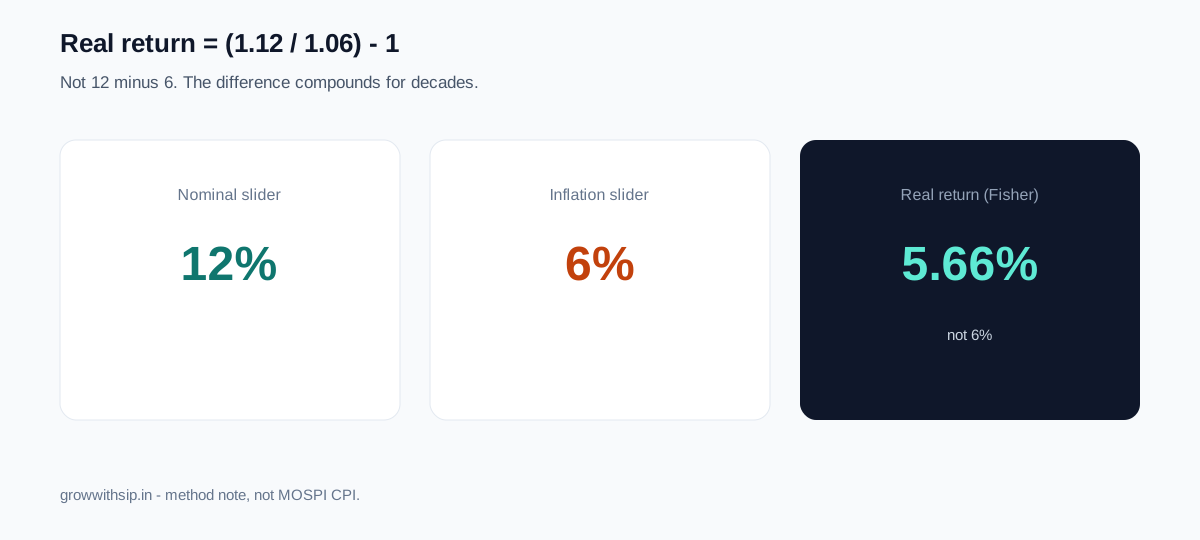
Real return is ((1 + nominal) / (1 + inflation)) − 1. At 12% and 6% that is about 5.66%, not 6%. Over 20 years the difference is not a rounding error. Subtracting 6 from 12 is a shortcut people use in WhatsApp groups. The SIP page’s real column uses the proper deflator on the corpus, which is the number that should size the plan.

The retirement calculator works backwards from a lifestyle you describe in today’s rupees, then grows expenses with inflation so the corpus is sized for the year you stop working, not for this year’s grocery bill. A “₹50,000 a month retirement” that is not inflated is a 2026 lifestyle wearing a 2046 date.
Which tools inflate and which do not
SIP, step-up SIP, lumpsum, goal planner, retirement, and SWP ask for inflation because the job is purchasing power. The FD calculator and PPF calculator show the contract or the notified rate. A 7% FD after 6% inflation is a thin real result after slab tax; I will not hide that subtraction inside an FD maturity so the page looks “smart.” EMI shows rupees you owe the bank, which are already nominal. Deflating an EMI schedule is a different question (your salary may rise) and is not in that loop.
Charts can still look “up and to the right” in nominal rupees while real value stalls. Read both columns. Read the yearly table note if you want the row-by-row version of the same deflator.
What we do not do
- We do not pull live MOSPI CPI into the slider. Rates on the page are yours to type.
- We do not tax-adjust the real column. Confirm LTCG, slabs, and cess when you file.
- We do not promise that 6% will be India’s inflation. It is a planning stub.
- We do not treat a 12% equity illustration as a forecast. That slider has its own warning.
A habit that takes two minutes
- Open SIP. Note nominal and real at 6%.
- Set inflation to 8%. Watch only the real column move.
- Open the goal planner with a house price quoted today, inflation on.
- If the required SIP breaks the salary, the goal date or the down payment has to change not the screenshot quality.
Confirm current CPI and your own expense inflation before you treat any real corpus as a promise.